Operator
Inputs, attention shifts, control timing, fatigue context, HR/HRV, workload indicators, recovery patterns, and other approved driver-context signals become part of the review record.
MOTORSPORTS // SESSION INTELLIGENCE
Machine Nerve gives drivers, coaches, and engineers one synchronized record of vehicle telemetry, driver inputs, physiology, audio, track context, feedback, and outcomes, then turns that evidence into debriefs, rules, and measurable change.
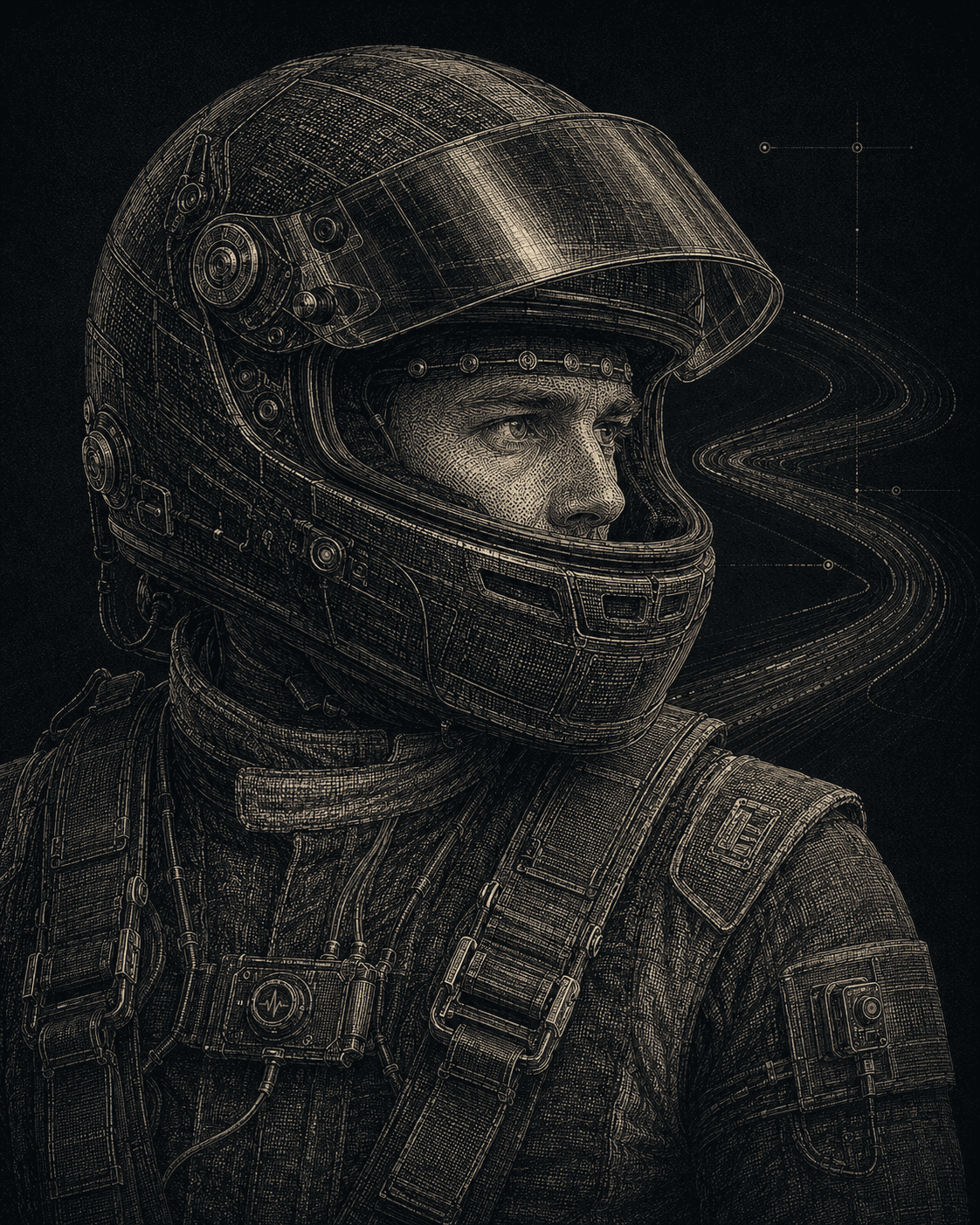
Inputs, attention shifts, control timing, fatigue context, HR/HRV, workload indicators, recovery patterns, and other approved driver-context signals become part of the review record.
Vehicle telemetry, speed, brake, throttle, steering, gear, tire, and simulator or logger behavior remain inspectable as source traces.
Track position, sector, corner, stint, conditions, radio context, media timing, and session phase explain where changes happened.
Capability Proof
Organize session evidence by lap, sector, corner, stint, delta, driver objective, and candidate event markers.
Compare machine response with throttle, brake, steering, gear, pedal timing, correction, repeatability, and recovery cost.
Use spatial position to anchor evidence to where the car and driver were operating.
Align video frames and audio-derived review markers to telemetry where source metadata and timing evidence are usable.
Bring HR/HRV, waveform, workload, and research-signal context into the timeline without making clinical claims.
Ask evidence-backed questions such as whether ABS intervention increased through a stint, where it appeared, and whether the supporting channels are strong enough to trust.
Translate training intent, such as a vMin focus in a corner zone, into guarded cues, notes, and measurable outcome markers.
Expose fidelity, source, materialization, confidence, freshness, and quality state before summaries or derived channels are trusted.
Machine Nerve turns laps into evidence. Vehicle telemetry, driver inputs, maps, synced video, audio features, radio context, operator context, feedback history, and outcomes can sit on the same review timeline, so a coach or engineer can move from outcome to cause without jumping between disconnected tools.
Motorsport is the first proving ground because racing compresses telemetry, human state, coaching, engineering, pressure, feedback, and measurable outcomes into every lap. The current motorsports surface is built for dense traces and session review first, not for a vague driver wellness layer bolted onto a lap chart.
The motorsports signal path starts with the driver, the machine, and the track. A useful session record should show what the car did, what the driver asked from it, what the track or simulator context changed, what feedback or coaching was in play, and which evidence supports that interpretation.
That can include lap, sector, corner, stint, speed, brake, throttle, steering, gear, map position, video frame, radio event, physiological context, coach note, rule state, and model-derived operator insight. When a source is weak, delayed, missing, or unsuitable for a claim, that state should remain visible instead of being averaged away.
A coach or engineer should be able to ask a session question and get an evidence path, not a detached summary. For example: was ABS intervention increasing through the stint, where did it appear, and were the supporting channels strong enough to trust? Machine Nerve can identify relevant channels, compare intervention by lap and corner, generate chart-ready outputs, and return an evidence-backed finding.
The same interlink can drive training rules. If a driver is working on vMin through a corner zone, that intent can become guarded logic: watch the zone, compare the trace, route a cue or note when conditions are right, and measure whether the next pass changed the signal.
Session video can carry more than footage. Where metadata and alignment are usable, Machine Nerve can turn source-rate audio into lap-aligned feature bins and candidate review markers such as curb strike, impact, tire squeal, limiter, gravel/off, clipping, or shift-like transients. Those markers are jump points for review, not definitive classifications.
Brake and control analysis is a roadmap direction, not a public product claim. The direction is clear: brake application timing, release shape, trail-braking behavior, pedal trace comparison, repeatability, and vehicle-outcome linkage belong in the same evidence record as lap delta and driver state.
Driver-context signals are not a replacement for engineering judgment. They are context for the review loop. Load, recovery, strain, timing, attention, and signal quality can help explain why the same input pattern produces a different outcome under different conditions.
Machine Nerve is designed for synchronized review and private pilot workflows. It does not claim universal logger support, automatic performance gains, definitive audio classification, fused crash detection maturity, or clinical interpretation of biometric signals.
Read What Is Human-Machine Performance Intelligence? for the broader signal-layer thesis.
Questions And Answers
These are the questions teams usually ask when they first map Machine Nerve to their environment.
Machine Nerve is not trying to replace core engineering telemetry. It connects telemetry with driver inputs, media, audio, physiological context, coaching notes, rules, feedback, and outcomes so the team can inspect the full human-machine performance trace in one replayable state record.
It can help move from outcome to evidence. The platform synchronizes lap, sector, corner, control input, machine response, media, operator context, and source quality so a coach or engineer can test a hypothesis instead of jumping between disconnected tools.
No. Biometrics and physiology are operator-context signals inside the performance record. They help reveal workload, recovery, physiological cost, and bandwidth under demand, but they do not replace telemetry, coaching, engineering judgment, or evidence boundaries.
That is the direction of AI Session Intelligence. A question such as whether ABS intervention increased through a stint can be grounded in telemetry channels, corner context, derived metrics, and prior laps before becoming a chart, finding, note, or rule proposal.
Machine Nerve is designed for manual, AI-assisted, or adaptive feedback inside defined guardrails. In motorsports, a training intent such as vMin through a corner zone can become a guarded cue, coach note, or debrief marker, then the next pass can be measured for signal change.
No. The platform measures whether feedback, coaching, rules, or training focus produced measurable performance signals. It supports better evidence and review; it does not claim automatic performance gains.
Pilot Access
Tell us what operator, machine, and environment signals you need to align.
Request Motorsports Pilot Access >